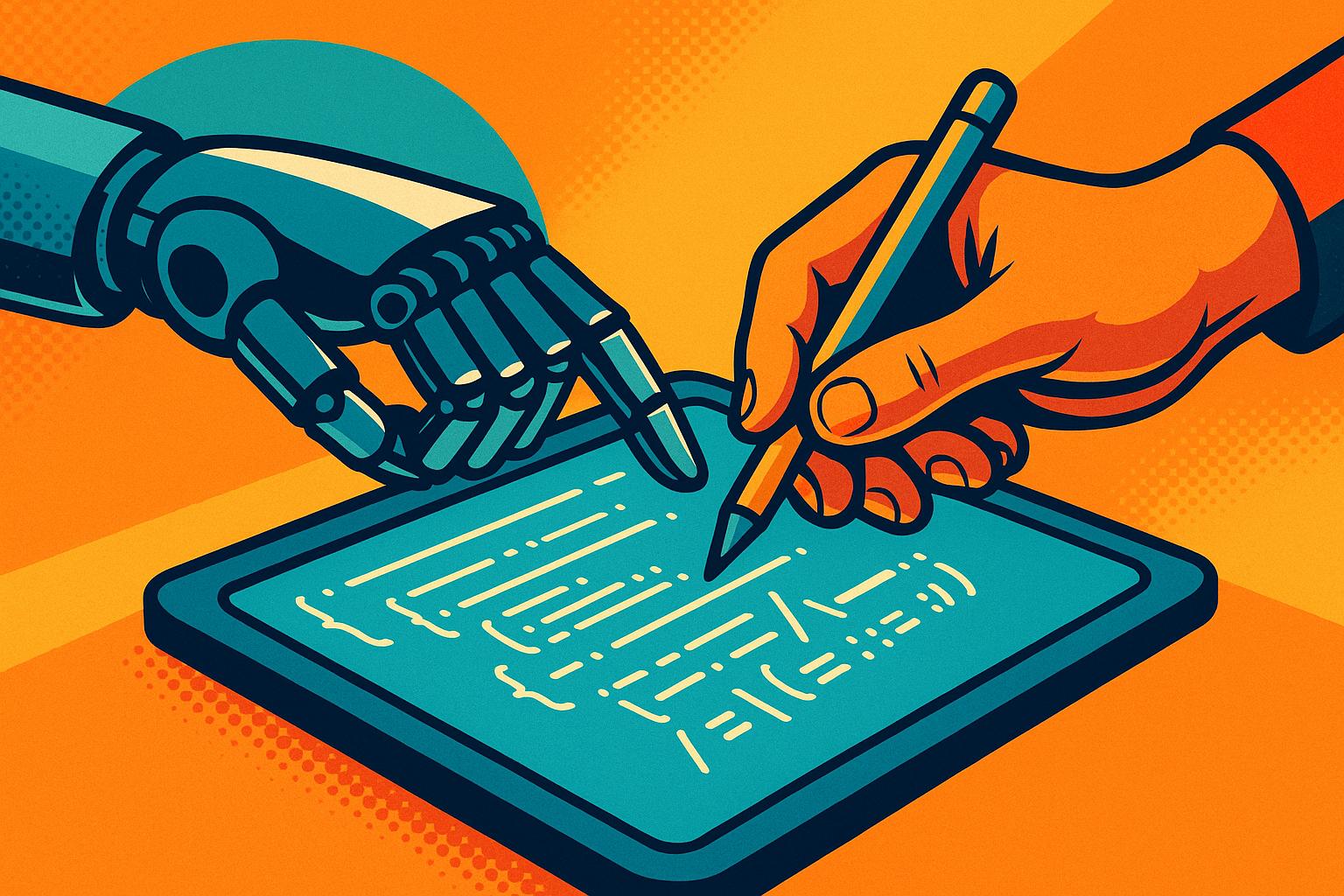
AI SDLC is changing how software is built by writing, testing, and improving its own code. Here’s what you need to know:
- Faster Development: AI tools help developers complete tasks twice as fast, cutting documentation time in half and speeding up code optimization by 66%.
- Cost Savings: Companies like Amazon save millions annually by using AI to automate coding tasks.
- End-to-End Automation: AI supports every phase of development, from planning and design to testing and maintenance.
- Human-AI Collaboration: AI handles repetitive tasks, while developers focus on quality control, solving complex problems, and strategic decisions.
AI SDLC Quick Stats:
- 78% of organizations are using or planning to use AI in software development.
- AI tools can save up to 50% of developer time on routine tasks.
- By 2026, 80% of enterprises will rely on AI-augmented testing.
AI isn’t replacing developers – it’s a powerful partner that speeds up work, reduces costs, and improves software quality. But human oversight remains essential for complex challenges and maintaining high standards.
Code 100x Faster with AI, Here’s How (No Hype, FULL Process)
AI SDLC in Modern Software Development
AI is reshaping how software is created, tested, and deployed. From analyzing requirements to generating code and refining algorithms, AI’s role in development has expanded significantly. One of the most exciting areas? Its ability to write code.
How AI Writes Code
Today’s AI coding tools learn by analyzing massive code repositories, identifying patterns, and predicting what comes next. According to research from GitLab, 78% of organizations are already using AI in their development processes or plan to adopt it within two years [1]. The impact is clear: Amazon’s Q Developer has reportedly saved the company the equivalent of 4,500 developer-years and around $260 million annually in development costs [3].
The adoption of AI tools isn’t just about cost savings – it’s about results. For instance, developers at one company accepted 90% of Tabnine‘s single-line coding suggestions, leading to an 11% productivity increase across their projects [4]. These tools are becoming indispensable for teams aiming to work smarter, not harder.
End-to-End Software Development Automation
AI is no longer limited to just writing code. It now supports every phase of the software development lifecycle. Here’s a quick breakdown of what AI can handle:
| Development Phase | AI Capabilities |
|---|---|
| Planning | Analyzing requirements and scoping projects |
| Design | Offering architecture recommendations and identifying design patterns |
| Coding | Automating code generation and refactoring |
| Testing | Detecting bugs and creating automated tests |
| Deployment | Simplifying release processes |
| Maintenance | Monitoring systems and applying updates |
"This year, the most competitive organizations will be those that take a strategic and intentional approach to AI…they will see massive transformations and opportunities for innovation, both within individual organizations and across the broader technology ecosystem."
- Lee Faus, Global Field CTO at GitLab [1]
AI Systems Building AI
One of the most fascinating developments is AI creating and improving other AI systems. This self-reinforcing cycle is accelerating progress at an unprecedented pace. For example, AI can help developers save up to 50% of their time on routine programming tasks [3], freeing them up to tackle more complex challenges.
Zineng Yuan, a Staff Machine Learning Engineer at Paytm, shared his experience:
"Zencoder is like having an AI pair programmer – it anticipates my needs, reduces repetitive tasks, and lets me focus on solving complex problems. A must-have for IntelliJ developers." [2]
This shift toward AI-driven development is helping organizations meet their goals faster and with fewer resources. From streamlining the software supply chain to improving continuous integration and deployment, AI is proving its worth. Many companies are now focusing on measuring ROI and quantifying AI’s impact on their development processes [1].
Business Benefits of AI SDLC
Faster Development and Growth
AI is reshaping how businesses approach development and growth by significantly speeding up processes. Recent data reveals that 75% of software executives have seen development times cut by as much as 50% thanks to AI and automation [6]. Companies like Microsoft and Google are using AI to spot bugs and predict potential failures early, which shortens release cycles [5]. This faster turnaround not only helps companies meet market demands but also positions them to seize new opportunities while keeping costs in check.
Lower Costs and Better Quality
AI-driven development doesn’t just save time – it also reduces costs and improves quality. By automating repetitive tasks, businesses can streamline their processes and reallocate resources more effectively. For example, integrating AI into CI/CD pipelines offers several advantages:
- Automated testing minimizes manual effort
- Real-time error detection and immediate solution suggestions
- Automated code merges and prioritized testing
- Human testers can shift focus to strategic, high-impact projects
Tools like Katalon are a prime example, offering continuous feedback and generating test cases automatically [5]. These efficiencies ensure consistent quality while lowering operational expenses. On top of that, AI’s ability to supervise compliance and identify vulnerabilities helps mitigate operational risks.
Meeting Standards and Reducing Risk
AI plays a vital role in maintaining high standards and managing risks by automating compliance and vulnerability detection. Sulabh Soral, Chief AI Officer at Deloitte UK, emphasizes this point:
"AI automates routine tasks such as code documentation, freeing developers to focus on more complex and creative aspects of their work." [3]
This shift allows developers to dedicate more time to strategic decisions while AI handles critical tasks like:
- Real-time security vulnerability analysis
- Ensuring compliance with best practices and industry standards
- Identifying potential bugs before production
- Reducing bias using high-quality, carefully audited training data
With AI increasingly integrated into development processes, it’s becoming an expectation rather than an option. In fact, 69.2% of software developers report that their clients now demand AI-powered solutions [5].
sbb-itb-5f0736d
Working with AI Systems
AI can speed up development, but it still depends on human oversight to maintain quality and solve tough challenges.
When Humans Need to Step In
Birgitta Böckeler emphasizes the importance of reviewing AI-generated code, saying, "Always carefully review AI-generated code. It’s very rare that I do NOT find something to fix or improve" [7].
There are several key scenarios where human oversight is crucial:
- Code Review and Quality Control: Developers must thoroughly review AI-generated code to ensure it meets long-term maintainability standards. Using quality tools and pre-commit hooks can make this process more effective [7].
- Complex Problem-Solving: Humans play a vital role in refining AI-generated solutions, especially in tricky situations. This includes:
- Adjusting prompts when the AI’s output isn’t quite right.
- Reverting to manual methods if needed.
- Navigating ethical concerns or unusual edge cases.
- Steering AI toward better outcomes.
Research has shown a noticeable rise in code churn with the widespread use of AI coding assistants [8]. This highlights the need for developers to adapt and develop skills for collaborating effectively with AI.
New Skills for Developers
As AI tools become more integrated into workflows, developers need to sharpen both technical and collaborative skills. Data indicates that tasks can be completed up to 55% faster with the help of these tools [9].
"AI isn’t replacing developers – it’s complementing their work, all while providing them with the opportunity to focus more on coding and building their skill sets, both technical and interpersonal" [9].
Here’s a breakdown of the skills developers should focus on:
| Skill Category | Key Competencies | Impact on Development |
|---|---|---|
| Technical | Prompt engineering, code review, testing | Helps validate AI outputs and use tools effectively |
| Communication | Clear documentation, teamwork, AI interaction | Improves collaboration and AI-human workflows |
| Problem-Solving | Critical thinking, system design, ethics | Ensures reliable and maintainable solutions |
To make the most of AI collaboration, developers should:
- Write clear, AI-friendly code with well-named variables and effective abstractions [8].
- Stick to consistent code quality practices [7].
- Embrace a growth mindset to stay current with AI advancements [9].
- Use pair programming to enhance code quality [7].
Statistics show that 70% of developers see major benefits from AI tools, and over 80% report improved teamwork [9]. Balancing automation with human oversight, while fostering trust and open communication, is key to ensuring software development remains reliable and strategic throughout its lifecycle [7].
What’s Next for AI SDLC and Hands Off Sofware Development
New AI Capabilities
AI is reshaping the way software is developed, and the numbers back it up. Today, AI contributes to 30% of Microsoft’s codebase, and Meta CEO Mark Zuckerberg envisions AI managing half of all development tasks within the next year [10].
Here’s a closer look at some of the advancements driving this transformation:
Natural Language Programming
AI is making coding easier and faster through conversational tools. For instance, AWS‘s Q Developer has updated 30,000 Java applications, resulting in an impressive $260 million in annual efficiency gains [10].
Automated Testing Integration
The future of testing is automated. Gartner predicts that by 2028, 75% of developers will rely on AI-powered coding tools, and by 2026, 80% of enterprises will incorporate AI-augmented testing into their workflows [10].
"As TuringBots become smarter and more autonomous and enterprises leverage their capabilities beyond just code generation, teams will automate more concatenated software development lifecycle (SDLC) tasks and build end-to-end apps that today take weeks or months to deliver in near real time."
– Diego Lo Giudice, Vice President Analyst at Forrester Research [10]
While these advancements are impressive, they don’t eliminate the need for human expertise. AI still has its limitations, and developers play a key role in bridging the gaps.
Current Limitations
Despite the rapid evolution of AI tools, challenges remain that require human intervention and oversight. Here’s a breakdown of some key limitations:
| Challenge | Limitation | Impact |
|---|---|---|
| Code Quality | Handles basic patterns but struggles with complexity | Needs human input for advanced features |
| Integration | Difficulty with complex systems | Can disrupt existing developer workflows |
| Security | May overlook emerging vulnerabilities | Requires human oversight for critical code |
| Maintenance | Sometimes generates overly complex code | Affects long-term usability and updates |
"For now, genAI can generate most of the basic, common, repeatable patterns. For advanced or complex scenarios, human-guided code development is required" [10]
Even as Anthropic CEO Dario Amodei suggests AI could soon handle 90% of coding tasks, strategic planning and human involvement remain essential [10].
"Humans must stay in the loop to understand what code is being deployed and how… understanding the logic of what it is doing and how it is doing it still are very relevant and prevalent" [10]
The road ahead also demands upskilling. Gartner estimates that by 2027, 80% of engineers will need to enhance their skills to effectively work alongside generative AI [11]. This underscores the ongoing need for human expertise to complement AI, ensuring a balanced and effective partnership in software development.
Conclusion
AI is transforming software development by blending human expertise with machine efficiency. Across the industry, this shift is redefining workflows and processes, pushing traditional methods into a more automated and strategic future.
Developers are moving away from manual coding toward roles that emphasize oversight and strategic decision-making. As Jayesh Govindarajan, Senior Vice President of Salesforce AI, explains:
"The vast majority of development – at least what I call the first draft of code – will be written by AI, but what developers do with that first draft has fundamentally changed." [12]
This shift allows developers to focus on higher-value tasks while routine coding is handled by AI. The adoption of AI tools is accelerating, with projections showing that over 80% of organizations will use AI-based development tools by 2026, compared to less than 5% in 2023 [15]. This evolution not only reshapes developer roles but also delivers measurable business benefits.
However, even as AI streamlines processes, human expertise remains critical. Mitchell Johnson, Chief Product Development Officer at Sonatype, underscores this point:
"AI is a powerful tool, but it does not replace human judgment when it comes to security, governance and quality." [14]
To thrive in this new landscape, organizations must prioritize building "AI-resistant" skills in their teams, such as system design and business domain knowledge [13]. At the same time, rigorous verification processes for AI-generated code are essential to ensure quality and security [14].
The future of software development will be defined by a collaborative partnership between human creativity and AI capabilities. With the Generative AI in Software and Coding Market expected to grow to $243.7 million by 2033 [16], companies that effectively combine AI precision with human insight are poised to lead the next wave of innovation.
FAQs
How does AI make software development faster and more efficient?
AI has transformed software development by speeding up processes and improving efficiency. It takes over repetitive tasks like code completion and debugging, which not only saves time but also reduces errors. This allows developers to channel their energy into tackling more complex and creative challenges.
Another game-changer is AI’s ability to generate code from natural language descriptions. This simplifies the creation of software components, cutting down on the time spent on routine tasks. By automating these aspects, AI helps developers produce better software faster, with less manual effort.
How does AI enhance the work of human developers instead of replacing them?
AI is transforming the way developers work by taking over tedious tasks like code documentation and testing. This means developers can spend more time on what really matters – creative problem-solving and strategic planning. On top of that, AI can spot bugs and vulnerabilities faster and with greater precision, leading to cleaner, more reliable code.
By simplifying workflows and providing smart recommendations, AI tools empower developers to tackle tough challenges more effectively and craft inventive solutions. This collaboration between human expertise and AI not only ramps up productivity but also makes the development process more dynamic and fulfilling.
What challenges does AI face in software development, and how can developers overcome them?
AI has made notable progress in software development, streamlining many processes. However, it still grapples with some critical challenges. These include an over-dependence on AI tools, potential issues with code quality, and security risks in the code it generates. While AI excels at automating tasks, it can stumble when faced with complex, nuanced, or highly creative problem-solving.
To tackle these issues, developers should take an active role in reviewing and refining AI-generated code to ensure it aligns with quality and security standards. Incorporating thorough testing and robust monitoring systems can help catch errors early in the process. Moreover, recognizing AI’s limitations is key – treating it as a powerful tool to enhance human expertise rather than a full replacement for critical decision-making or intricate tasks. By striking this balance, development teams can benefit from AI’s strengths while minimizing its risks.