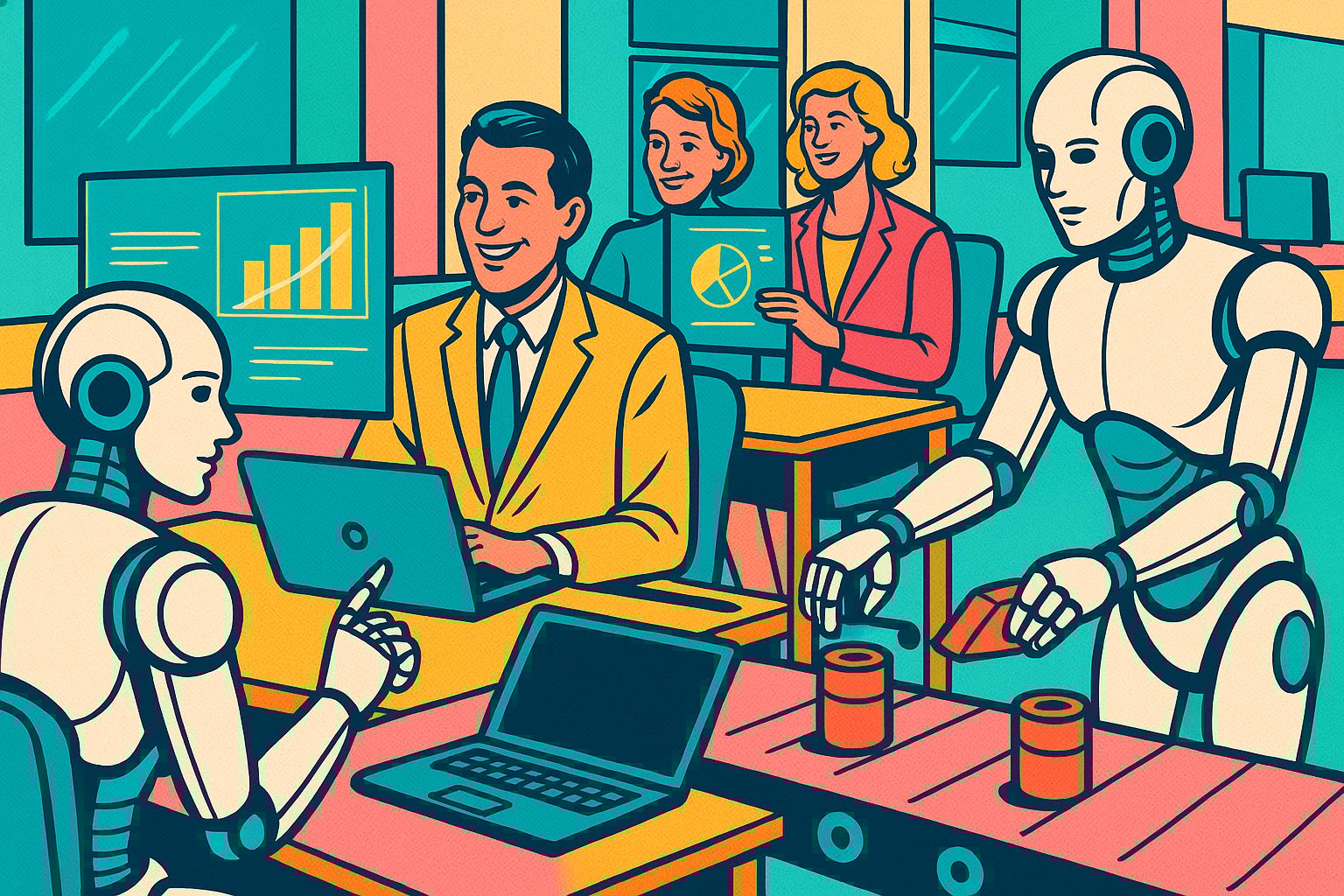
The AI Workforce is transforming the workplace – and fast. In fact, there’s strong contention that an AI Workforce could become more valuable IP than your products or services. Here’s what you need to know about the top 5 benefits of using an AI Workforce:
- They Never Quit: AI works 24/7 without breaks, reducing downtime and boosting productivity.
- The Workforce is the IP: AI Workers become compounding IP that scales, differentiates, and never walks out the door.
- You Can Replicate Your Best Employees: AI replicates top performers’ skills, scaling expertise across your business.
- They Learn From Your Data: AI trained on your unique data becomes a subject matter expert in your business operations.
- They Turn Process Into Salable Product: What used to be operational cost now becomes a monetizable solution.
Quick takeaway: An AI Workforce doesn’t just automate tasks – it creates lasting value by improving efficiency, scaling expertise, and generating revenue. Let’s explore each benefit.
1. They Never Quit, Get Sick, or Take PTO
Always-on execution with no downtime
Picture this: your most reliable employee never calls in sick, never takes a vacation, and never experiences burnout. That’s essentially what an AI Workforce brings to the table. While a staggering 71% of full-time employees report feeling burned out [2][4], AI workers operate consistently, around the clock.
Recent advancements show that some AI models can work continuously for up to seven hours without losing efficiency [1]. This capability lays the groundwork for minimizing the downtime that traditionally hampers human-driven operations.
But running AI 24/7 isn’t without its hurdles. As Brian Jackson, principal research director at Info-Tech Research Group, points out:
“AI has a short-term memory window and high hardware demands because it requires high-end GPUs or TPUs working at max performance to create the environment.” [1]
Jon Brewton, founder and CEO of Data2, adds that achieving true 24-hour operation will depend on developing more affordable, energy-efficient hardware and smarter systems for managing trust [1]. Despite these challenges, the benefits of uninterrupted AI operations are undeniable.
The immediate payoff? AI-driven productivity eliminates bottlenecks caused by human downtime. Processes that would normally pause can continue seamlessly.
Interestingly, while 61% of workers worry that AI in the workplace could increase burnout [1][3], AI itself supports steady, reliable operations without fatigue. Industries across the board are already reaping the rewards of this reliability.
Take Siemens‘ Amberg Electronics Plant as an example. By incorporating machine learning to predict equipment failures, they’ve managed to reduce unplanned downtime by an impressive 78% since 2020 [6].
The financial benefits are just as striking:
- No need to replace skilled workers, which costs around $40,000 per replacement [5].
- Operations continue without any performance dips.
On top of that, AI-powered predictive maintenance can slash unplanned downtime by 30–50% and extend equipment lifespan by 10–40% [6]. These improvements don’t just save money – they also enhance overall efficiency.
This move toward continuous operation does more than boost productivity; it reshapes how businesses think about resource allocation and capacity planning. Instead of building in buffers for human limitations, companies can now design leaner operations that make the most of every hour. The result? Not just higher efficiency but a shift toward scalable innovation and long-term enterprise growth.
2. They Create the IP, And They Become the IP
Turning the Workforce Into Appreciating Assets
AI can be thought of as just another piece of licensed software. But unlike traditional automation, these AI Workers don’t just create IP—they become it: scalable, compounding assets that build enterprise value.
This is a game-changer for how businesses think about value creation.
To put this into perspective, global data creation is projected to exceed 394 zettabytes by 2028 [8]. Imagine leveraging this vast data landscape to create systems capable of analyzing images, generating tagging keywords with confidence scores, producing transcripts, segmenting scenes, and detecting key elements – all with multilingual support [9]. This process showcases how businesses can scale up their intellectual property.
The financial upside is hard to ignore. Service-based companies typically see valuations of 1–3 times their revenue. But firms that integrate Intellectual Property, automation, and scalable solutions often achieve revenue multiples of 5–15 [13].
Specialized Expertise Through Your Data
When you train AI workers on your unique business data, they develop expertise tailored specifically to your operations. Unlike off-the-shelf AI tools, these systems are deeply embedded in your processes, institutional knowledge, and proprietary workflows.
“While the creator of the GAI algorithms may be able to assert some ownership over the downstream tools, the value creation for specialized implementations relies heavily on the training data.” – Dr. Alan Marco, Chief Economist, Ocean Tomo [12]
This tailored training creates a competitive edge. AI workers also act as a repository for decades of institutional knowledge, preserving expertise in industries where an aging workforce is a concern [11]. They capture insights that might otherwise be lost, including unwritten or hard-to-access information [10].
The market potential reflects the growing importance of AI workers. By 2030, spending on AI agents is expected to skyrocket from $5.1 billion in 2024 to $47.1 billion, with a compound annual growth rate of 44.8% [10]. Advances in natural language processing are a significant factor driving this growth.
Monetizing Internal Workflows
AI workers don’t just optimize your internal processes – they can also turn those processes into entirely new revenue streams. The real magic happens when companies realize their optimized workflows have value beyond their own operations.
Here are a few real-world examples of how businesses are monetizing their internal processes:
- A media technology company developed a self-serve AI platform for automated video enhancement and now sells subscriptions for it [13].
- A regulatory consulting firm created an AI-powered compliance tracking system, offering subscription-based monitoring services [13].
- A legal firm built an AI-driven tool for contract risk assessment and licenses it to enterprises for recurring revenue [13].
- A healthcare consulting firm implemented an AI forecasting system for patient demand and operational risks, which hospitals now subscribe to [13].
The numbers back up these transformations. Businesses adopting generative AI solutions are already reporting up to 25% improvements in quality, productivity, customer experience, cost reductions, and workforce efficiency [15]. Additionally, 89% of executives are speeding up their generative AI initiatives [15].
When an AI worker masters a workflow, you’ve essentially created intellectual property. This IP becomes a lasting asset, with intangible assets now accounting for over 90% of the value of AI-driven companies [14]. In this sense, your AI workforce can become one of your most valuable resources.
This shift – from viewing AI as an expense to seeing it as an asset – redefines how businesses approach productivity and growth. Your AI workforce doesn’t just complete tasks; it lays the groundwork for new revenue streams, competitive advantages, and long-term success.
3. You Can Replicate the Skills of Your Best Employees
Bottling and Sharing Expertise Across Your Organization
What if you could take the skills and knowledge of your top-performing employees and make them available across every department? With AI, this is no longer just a dream. AI employee clones can replicate an individual’s tone, reasoning, preferences, and expertise with impressive accuracy [17]. These digital versions are trained using a wealth of data – past communications, documents, tasks, and even meeting transcripts [17]. The result? Your best employees’ strengths can be scaled consistently throughout your organization [17].
In fact, studies reveal that personality replication can reach 85% accuracy after just a two-hour interview with an AI model [18]. This means you can create a network of AI agents tailored to represent key roles in your company. For example, your marketing team could benefit from a clone of your most creative marketer, while your customer service department might gain a digital version of your most empathetic support agent. These AI clones not only ensure consistent expertise but also enable operations to run seamlessly, even outside traditional working hours.
Around-the-Clock Performance Without Fatigue
Unlike their human counterparts, AI clones don’t need rest. They deliver consistent, high-quality output 24/7 [17]. Whether it’s customer support, analysis, or decision-making, these digital counterparts ensure your business never misses a beat. This is especially beneficial for global teams, as they can access expert guidance regardless of time zone differences.
One CEO even reduced her weekly working hours from 40–50 to a manageable 32–35 hours by delegating routine tasks to her AI clone [16]. The clone efficiently handled emails, routine decisions, and administrative duties, allowing her to focus on strategic initiatives. This example highlights how AI clones can free up valuable time for leadership to focus on what truly matters.
Tailored Expertise Through Business-Specific Learning
AI clones don’t just copy skills – they evolve by learning from your company’s unique data, becoming increasingly specialized in your workflows and processes. Imagine junior team members learning directly from a virtual version of your company’s most seasoned expert [17]. This eliminates the bottleneck of relying on one person to train others, making expertise infinitely scalable.
AI can also analyze successful projects or sprints and transform the insights into actionable checklists or playbooks to improve future efforts [19]. This doesn’t just capture what top performers do but also how they think, adapt, and make decisions in various scenarios.
“AI shouldn’t just generate content. It should generate insight and structure – based on what’s working.” [19] – Sudeep Patra
Companies using AI-powered training tools have reported onboarding processes that are up to 50% faster. These tools ensure that critical knowledge remains accessible, even during times of employee turnover.
“Optimization isn’t about fixing what’s broken. It’s about scaling what works.” [19] – Sudeep Patra
In short, AI clones are the ultimate solution for scaling expertise. By replicating what works best in your organization and making it available to everyone, these digital counterparts can revolutionize how your business operates.
4. They Learn From Your Business Data
Specialization Through Unique Business Data
An AI workforce becomes truly effective when it’s trained on your organization’s own data. This isn’t about generic AI capabilities – it’s about creating systems that understand your specific challenges, industry nuances, and customer behaviors. In fact, 72% of top-performing CEOs believe that the most advanced generative AI tools provide a competitive edge, but only when paired with enterprise-specific data [21].
Here’s the difference: general AI might provide basic, one-size-fits-all responses. But AI systems trained on your proprietary data become experts in your operations. They don’t just assist – they evolve into specialists who understand the intricacies of your business. This tailored expertise allows AI to adapt and improve, creating a lasting advantage.
Some leading companies are already harnessing this potential:
- Morgan Stanley: Used GPT-4 fine-tuned on 100,000 internal documents.
- BCG: Deployed custom AI to deliver faster, more accurate client insights.
- ScottsMiracle-Gro: Built an AI “gardening sommelier” using product catalogs.
- Volkswagen of America: Created a virtual assistant from vehicle manuals.
The results speak volumes. McKinsey reports that leveraging internal data for sales and marketing can drive above-average market growth and increase EBITDA by 15% to 25% [21]. This isn’t just about efficiency; it’s about revealing hidden value in your data and using it to fuel growth.
AI Workforce: Always-On Execution With No Downtime
An AI Workforce doesn’t just learn – it’s always working. They analyze massive amounts of data in real time, delivering insights, forecasts, and actionable recommendations. This means faster, smarter decisions without interruptions [20].
Take JPMorgan Chase‘s COIN platform, for example. In 2023, this AI system completed tasks in seconds that previously required 360,000 hours of lawyer time annually. It also cut loan-servicing errors by 93% [20]. That’s not just speed – that’s precision and reliability that continuously improves.
Ping An Insurance in China offers another glimpse of AI’s potential. By 2024, 60% of its claims were processed without human intervention, leading to efficiency gains of 40-70% [20]. These systems don’t just handle routine tasks – they refine their understanding of risks and fraud patterns with each claim.
The Mayo Clinic saw a 29.2% boost in radiologist productivity in 2023, thanks to an AI-enhanced diagnostic system. Not only did it allow radiologists to analyze more images, but it also reduced interpretation errors by 11% [20]. This system grows smarter with every diagnosis, advancing its ability to detect medical patterns.
“AI is no longer just a tool of the future – it’s a powerful asset available today to revolutionize process improvement.” [22] – Scott Converse, CPED Program Director
These advancements don’t stop at efficiency. AI systems create sellable digital assets. Each member of an AI Workforce accumulates knowledge, becoming more valuable over time. This expertise can even be shared or licensed to other organizations, opening up new revenue streams.
For example, Toyota implemented AI-powered visual inspection systems at its Japanese plants in 2023. These systems reduced defect detection time by 80%, improved accuracy by 20%, and boosted overall productivity by 27% [20]. With each inspection, the AI becomes sharper, redefining quality standards.
Beyond individual tasks, AI Workforce systems analyze market trends, customer behavior, and performance metrics to refine strategies and optimize decision-making [20]. This compounding effect turns AI into a driver for scalable innovation.
Amazon is another standout example. Between 2019 and 2023, its AI-driven warehouse robotics and logistics systems increased order fulfillment productivity by 32%. This allowed for faster delivery times while reducing the need for human resources per package [20]. The more these systems are used, the more efficient they become.
The takeaway? AI systems thrive when they’re trained on your unique data. They don’t just perform tasks – they grow into specialized experts that understand your business inside and out, transforming operations into engines of growth and innovation.
sbb-itb-5f0736d
5. They Turn Process Into Product
Turning Workflows into Digital Assets That Generate Revenue
An AI workforce can evolve from being a cost burden to becoming a source of income. By mastering your internal workflows, AI systems transform into assets that can be deployed, licensed, or even sold to other organizations facing similar challenges.
Here’s an example of how this works: A large retail bank recently implemented AI agents to tackle account-opening issues. These agents first detected error spikes from core banking servers when branch desktops attempted to open accounts. Other agents confirmed that the error rates met incident thresholds and escalated high-priority tickets. Additional agents then analyzed the systems, pinpointed the problems, and proposed solutions [25]. What started as an internal process became a scalable solution that could be monetized.
This shift isn’t just theoretical. According to McKinsey, AI applications could generate between $1.4 trillion and $2.6 trillion in value across industries by 2025 [23]. By turning internal improvements into sellable solutions, companies can unlock entirely new revenue streams.
Monetizing Internal AI Processes
AI automation doesn’t just create efficiency – it creates revenue opportunities. Gartner reports that AI can boost productivity in specific business processes by up to 40% [23]. These gains can be leveraged in several ways:
- Direct sales: Selling AI tools as standalone products or add-ons.
- Licensing: Allowing other companies to use your trained AI systems.
- Subscription models: Offering ongoing access to AI-powered workflows.
- Consulting services: Assisting other organizations in implementing similar AI solutions.
The global AI agent market is expected to surpass $50 billion by 2030, with AI agent startups alone raising over $3.8 billion in 2024 [27]. This trend underscores the potential for businesses to shift from traditional cost centers to revenue-generating entities.
Data monetization offers another powerful avenue. As Barbara Wixom, Principal Research Scientist at MIT‘s Center for Information Systems Research, explains:
“Data monetization is when you start with data as an organizational resource, and you end up with money and economic resources, and there’s a conversion that happens in the organization.” [26]
AI systems excel at this conversion. They transform raw data into actionable insights, automate processes, and create sellable digital assets that drive ongoing revenue. For instance, a digital sales agent sending 100 emails per day could generate $300–$800 per month [27]. The scalability of these systems enables high-margin revenue streams that grow more profitable over time.
Additionally, 73% of executives have indicated plans to use generative AI (GenAI) to reshape their business models [24]. This widespread adoption presents massive opportunities for companies that can package their AI expertise into marketable products.
Scaling Expertise for Broader Impact
AI doesn’t just monetize processes – it scales expertise, enabling businesses to replicate success across industries. Once an AI Workforce masters a workflow, it can be adapted, customized, and deployed in new markets or use cases.
This ability to replicate and scale transforms how businesses operate. Instead of selling time or resources, companies shift to selling outcomes and capabilities. This transition often results in higher valuations and more predictable revenue streams.
As Shervin Khodabandeh, Senior Partner at BCG, puts it:
“If your AI efforts are not tied to your business strategy or your corporate strategy or how you are getting more efficiency or revenue or growth, then those are probably wasted.” [26]
The companies that thrive in this space recognize that AI doesn’t just improve operations – it creates entirely new value propositions. By turning operational improvements into competitive advantages, they open doors to sustained growth and enterprise value through consistent innovation and delivery.
AI Workforce Benefits in Business: Efficiency & Workforce Augmentation Proven #ROI in #GENAI #aiinnovation #AI
Traditional Workforce vs AI Workforce Comparison
When comparing traditional workforce models to AI-driven systems, the differences go far beyond simple automation. Traditional setups depend heavily on human-driven processes, where growth is tied directly to headcount. On the other hand, AI systems thrive on continuous learning and adaptation, delivering exponential value rather than linear scalability. Let’s break down how these two approaches differ in terms of cost, performance, and strategic impact.
Traditional workforce management often struggles with inefficiencies and errors due to manual processes[28]. AI-powered solutions, however, handle routine tasks with speed and precision, offering insights that manual methods simply can’t match[28]. For example, AI systems process data in real time, while traditional methods may take hours or even days[28]. A striking statistic highlights this gap: 95% of AI-driven decisions are data-based, compared to just 45% in traditional approaches[28].
Cost Structure and Scalability Differences
When it comes to cost, traditional workforces may seem cheaper at first glance, but they often incur higher ongoing expenses due to inefficiencies and labor-intensive processes[31]. AI systems, while demanding a larger initial investment, ultimately reduce operational costs by streamlining workflows and improving efficiency over time[29].
Scalability is another area where AI shines. Traditional methods require additional hiring, training, and management to handle increased workloads, which can bog down operations[28]. In contrast, AI systems adapt seamlessly to higher demands without significant changes or added costs[29].
Strategic workforce planning with AI can cut an average of 10% from annual labor budgets by reducing attrition, optimizing staffing, and improving resource allocation[7]. Additionally, AI can slash hiring timelines by up to 75%, allowing businesses to scale faster and more effectively[30].
Performance and Reliability Comparison
The differences in performance and reliability are stark. AI tools take on 35% of routine daily tasks, freeing up human workers to focus on strategic and creative contributions[29].
| Comparative Aspects: Traditional Workforce vs AI Workforce | Traditional Workforce | AI Workforce |
|---|---|---|
| Availability | Limited by work hours, sick days, and vacations | Operates 24/7 without interruptions |
| Learning Capability | Requires manual training and updates | Learns and improves continuously through algorithms |
| Error Rate | Susceptible to human errors and inconsistencies | Automated checks significantly reduce mistakes |
| Scalability | Dependent on hiring and managing more staff | Adjusts to workload changes automatically |
| Decision Speed | Can take hours or days for complex tasks | Provides real-time insights and recommendations |
| Cost Structure | Includes salaries, benefits, and training costs | High upfront cost but lower long-term expenses |
Organizations that adopt AI workflows report measurable improvements in both cost efficiency and productivity[29]. Sarah Choudhary, CEO of Ice Innovations, sums it up well:
“AI automates repetitive tasks, but it also augments human capabilities, enabling workers to focus on strategic and creative tasks.”[33]
The Strategic Advantage
The traditional workforce model relies on individual labor, leading to linear growth. In contrast, AI systems create digital assets that grow in value over time, offering compounding benefits. AI workflows consistently outperform manual processes in speed, accuracy, and scalability[29]. This allows companies to respond more quickly to market shifts and customer needs.
In Japan, a survey revealed that workplaces using AI saw a 5.6% increase in overall productivity[32]. Rather than replacing human workers, many industry leaders are adopting hybrid models where AI handles repetitive tasks, and humans focus on innovation and strategy. These contrasts highlight why AI-driven workforces are reshaping business models in ways traditional methods cannot.
Conclusion
The rise of the AI Workforce isn’t just a passing trend – it represents a major transformation in how businesses operate and create value. Shifting from traditional hiring practices to training AI Workers signals a profound change in mindset. While traditional hiring emphasizes finding the right talent, the future leans toward equipping AI Workers to handle intricate workflows and make informed decisions. As highlighted earlier, these AI Workers are reshaping operational efficiency and driving innovation across industries.
Take Zendesk’s AI chatbots as an example – they manage up to 70% of routine customer service inquiries[34]. This allows human teams to focus on higher-level, strategic tasks. Companies leveraging AI workflows report improved cost efficiency and productivity, showing how AI amplifies human capabilities by scaling intellectual property and delivering AI-powered results.
What sets trained AI Workers apart is their ability to evolve into valuable digital assets. They learn and retain critical processes, adapt to unique organizational needs, and grow beyond traditional limitations. By continuously learning and refining their capabilities, these AI Workers not only optimize internal operations but also create long-term enterprise value that compounds over time.
For organizations looking to embrace this shift, the key lies in starting now. Clear goals, small-scale pilots, and well-defined use cases can unlock the potential of AI in tangible ways.
The future of work is changing, and your next hire might not be human. Companies that see AI Workers as strategic partners rather than mere tools will lead the way. The question isn’t whether to start – it’s how soon you can begin training one.
FAQs
How do AI systems customized with a company’s data outperform generic AI tools?
Custom AI systems built around a company’s unique data can give businesses a real advantage, tackling specific challenges with unmatched precision. Unlike off-the-shelf AI tools, these tailored systems align closely with your workflows, delivering sharper, context-driven insights and solutions.
This approach not only boosts efficiency and growth potential but also integrates seamlessly into your operations. It can cut costs by streamlining processes and uncovering overlooked opportunities – especially valuable in industries with intricate or highly regulated environments. By tapping into your proprietary data, these AI systems help keep your business ahead in today’s fast-changing landscape.
What challenges might businesses face when implementing a 24/7 AI workforce, and how can they overcome them?
Implementing a 24/7 AI workforce offers plenty of advantages, but it does come with its fair share of challenges. One major obstacle is getting the AI systems up and running. This involves dedicating time, resources, and ensuring access to high-quality data. For businesses to navigate this effectively, it’s important to start with a clear plan, focus on organizing and cleaning their data, and bring in skilled professionals to guide the process.
Another issue lies in integrating AI into existing workflows and systems. Compatibility problems or even employee pushback can make adoption slower than expected. To ease this transition, businesses should roll out AI gradually, provide thorough training for their teams, and emphasize that AI is there to support human efforts – not replace them.
Finally, ongoing monitoring and upkeep is crucial to keep AI systems running smoothly and accurately. Regularly evaluating performance and applying updates can help avoid errors and ensure the AI workforce continues to add value over time.
How can businesses turn their internal AI processes into profitable revenue streams?
Companies have the potential to turn their internal AI operations into lucrative revenue streams by transforming workflows into sellable digital products. This could mean developing AI-powered tools, platforms, or APIs that other businesses can license or subscribe to, creating a steady source of income.
Another approach is using AI automation to build services like SaaS products tailored to specific industry challenges. By tapping into their own data and expertise, businesses can convert internal efficiencies into scalable solutions, broadening their portfolio and unlocking fresh revenue opportunities.