TLDR: THE BIG TAKEAWAY
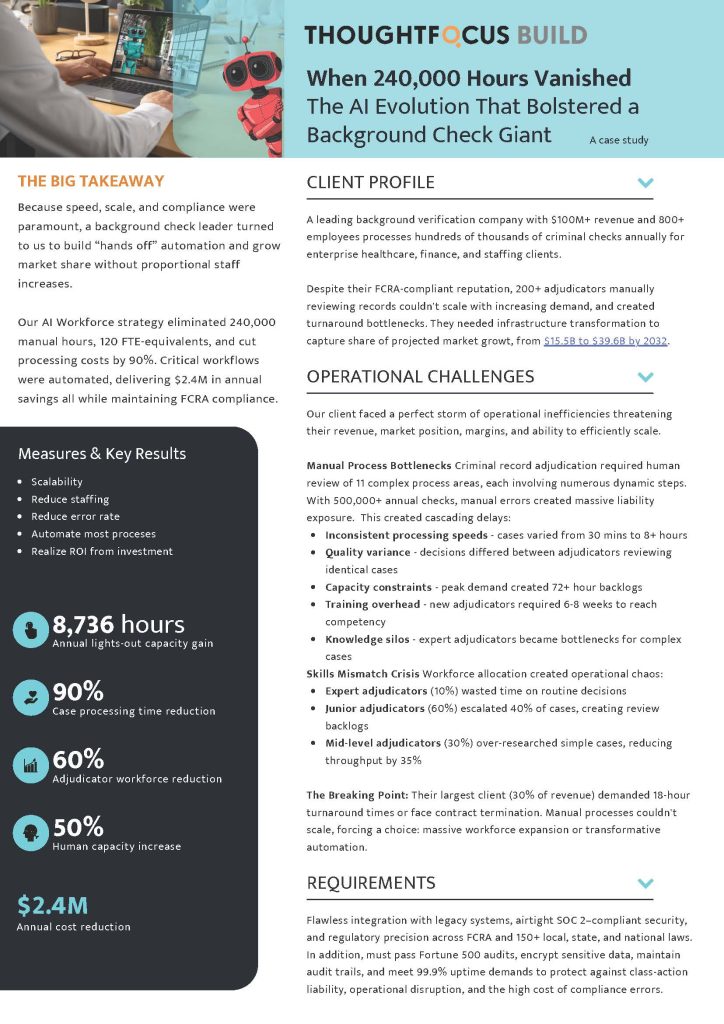
Because speed, scale, and compliance were paramount, a background check leader turned to us to build “hands off” automation and grow market share without proportional staff increases.
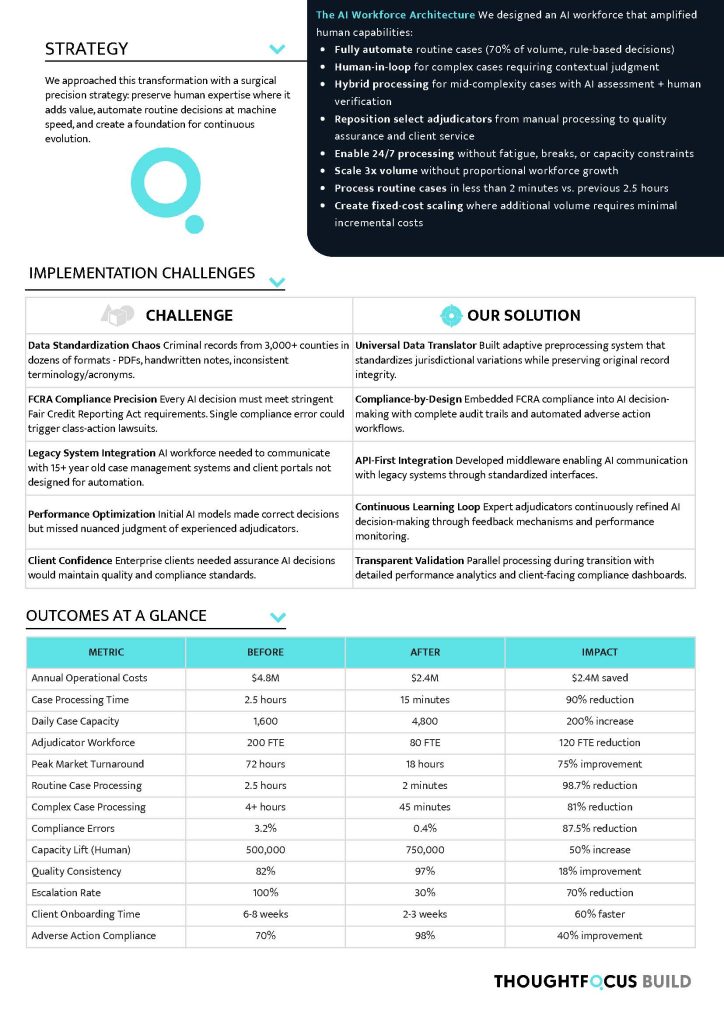
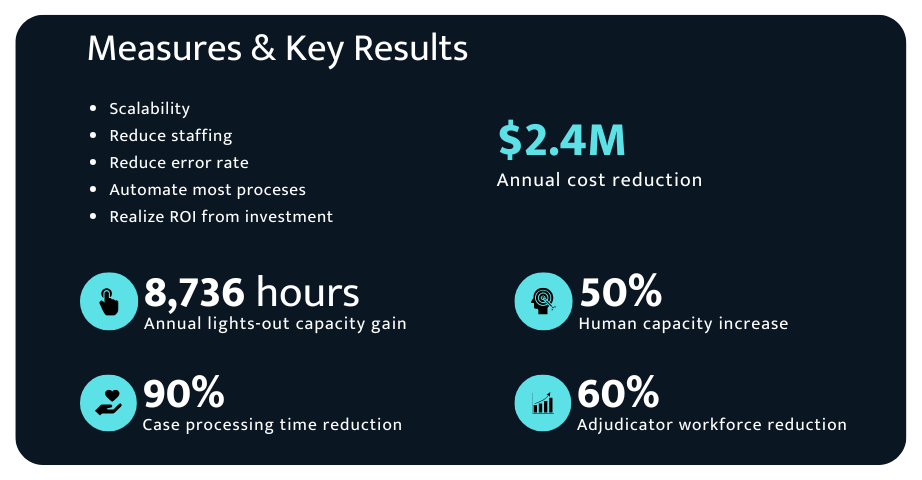
Our AI Workforce strategy eliminated 240,000 manual hours, 120 FTE-equivalents, and cut processing costs by 90%. Critical workflows were automated, delivering $2.4M in annual savings, all while maintaining FCRA compliance.
Client Profile
A leading background verification company with $100M+ revenue and 800+
employees processes hundreds of thousands of criminal checks annually for
enterprise healthcare, finance, and staffing clients.
Despite their FCRA-compliant reputation, 200+ adjudicators manually reviewing records couldn’t scale with increasing demand, and created turnaround bottlenecks. They needed infrastructure transformation to capture share of projected market growth, from $15.5B to $39.6B by 2032.
Operational Challenges
Our client faced a perfect storm of operational inefficiencies threatening their revenue, market position, margins, and ability to efficiently scale.
Manual Process Bottlenecks Criminal record adjudication required human review of 11 complex process areas, each involving numerous dynamic steps. With 500,000+ annual checks, manual errors created massive liability exposure. This created cascading delays:
- Inconsistent processing speeds – cases varied from 30 mins to 8+ hours
- Quality variance – decisions differed between adjudicators reviewing identical cases
- Capacity constraints – peak demand created 72+ hour backlogs
- Training overhead – new adjudicators required 6-8 weeks to reach competency
- Knowledge silos – expert adjudicators became bottlenecks for complex cases
Skills Mismatch Crisis Workforce allocation created operational chaos:
- Expert adjudicators (10%) wasted time on routine decisions
- Junior adjudicators (60%) escalated 40% of cases, creating review backlogs
- Mid-level adjudicators (30%) over-researched simple cases, reducing throughput by 35%
The Breaking Point: Their largest client (30% of revenue) demanded 18-hour turnaround times or face contract termination. Manual processes couldn’t scale, forcing a choice: massive workforce expansion or transformative
automation.