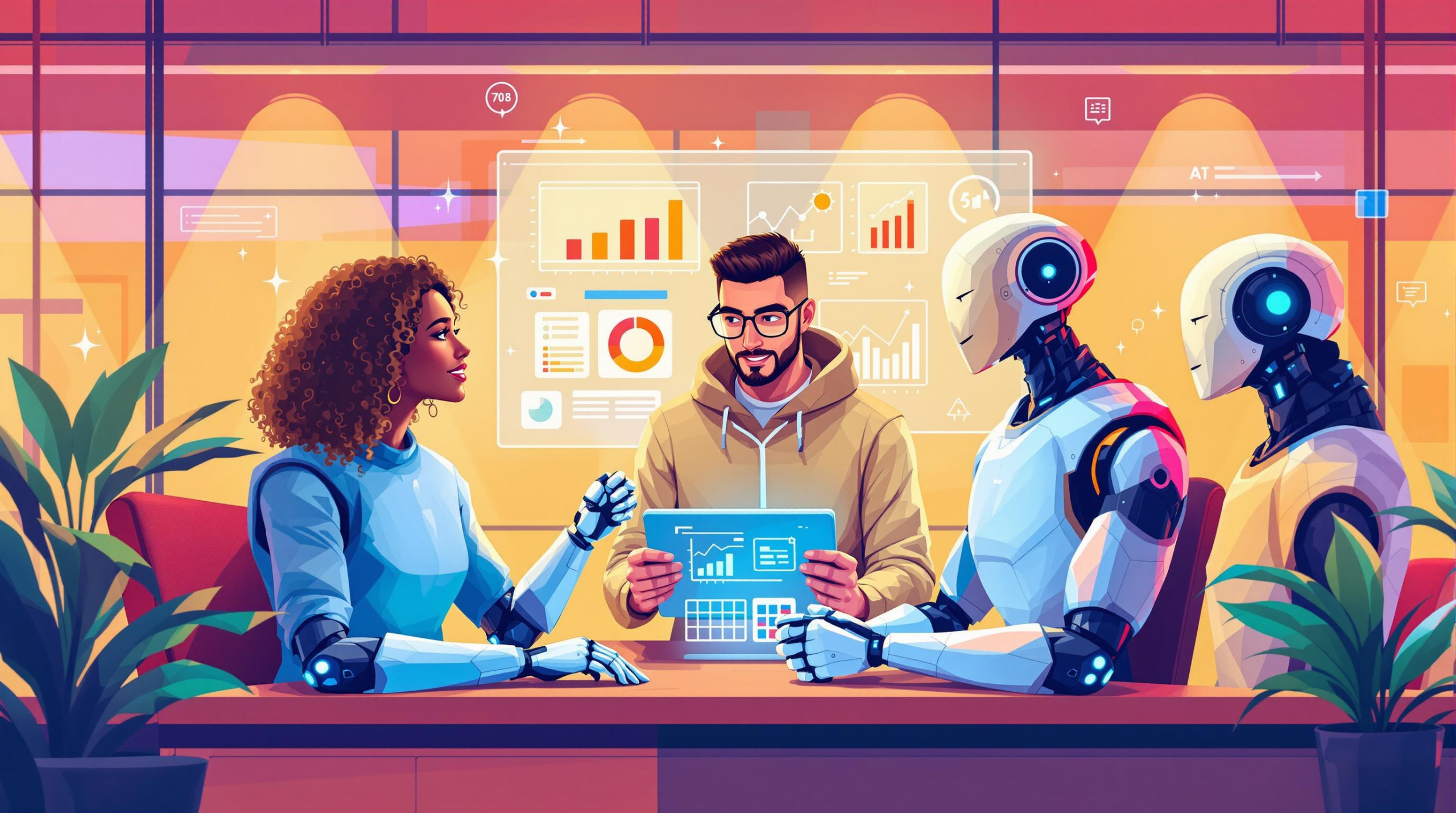
Why the Future Workforce Will Combine Humans and AI Employees

When humans and AI work together effectively, organizations can see improvements across various areas. Here's how this collaboration makes a difference.

By 2025, AI will handle more routine tasks, freeing humans to focus on creativity and critical thinking. Companies are already seeing results: AI is creating 97 million new jobs while requiring 375 million workers to reskill by 2030. The key? Combining human judgment with AI’s speed and precision.

Key Takeaways:

  • Human Strengths: Judgment, empathy, and critical thinking.
  • AI Strengths: Data processing, automation, and 24/7 operation.
  • Examples: Zara uses AI for inventory, and Netflix‘s AI drives 80% of user activity.
  • Benefits: Faster decisions, fewer errors, better customer service, and new revenue streams.
  • Challenges: Ethical concerns, workforce training, and data security.

Next Steps for Businesses:

  1. Start small with AI pilot projects.
  2. Train employees in AI tools and soft skills.
  3. Focus on ethical AI and secure data practices.

The future workforce isn’t about replacing humans but enhancing their potential with AI.

Balancing AI and Human Interaction in the Future Workforce

How Humans and AI Complement Each Other

The workplace thrives when human insight and AI efficiency come together. By combining their strengths, humans and AI form powerful teams that can achieve exceptional results.

Human Skills: Judgment, Empathy, and Critical Thinking

Humans bring unique qualities like judgment, emotional intelligence, and critical thinking to the table. As AI becomes more prevalent, these soft skills are becoming increasingly important for long-term career success [2].

Some key human strengths include:

  • Strategic Vision & Innovation: Leveraging intuition and experience to understand the bigger picture and develop creative solutions.
  • Emotional Intelligence: Recognizing social cues and building strong relationships through empathy.
  • Change Management: Guiding teams through transitions with clear communication and inspiration.

“Soft skills become a new form of job security and career survivability as roles evolve with emerging technologies.” [2]

AI Capabilities: Speed, Accuracy, and Scale

AI systems excel in areas where precision, consistency, and large-scale data processing are needed. In fact, the McKinsey Global Institute estimates that current technologies could automate about 30% of work activities by 2030 [2].

AI StrengthBusiness Impact
Data ProcessingProcesses millions of data points rapidly.
24/7 OperationWorks continuously without fatigue.
Pattern RecognitionSpots trends that humans might overlook.
Task AutomationMinimizes errors in repetitive tasks.

These strengths are most effective when combined with human decision-making.

Working Together: Humans Plus AI

Real-world examples highlight the power of human and AI collaboration:

Zara’s Inventory Management: AI predicts demand by analyzing real-time sales data, while human managers make key decisions on stock distribution and special promotions [3].

Financial Fraud Detection: AI flags unusual transactions, but human analysts investigate and make the final call on potential fraud [3].

“When AI and human teams collaborate, they can tackle the key challenges that slow businesses down.” – Sagar Pandya, VP of Sales for AI and Digital Transformation, Ntiva [3]

This partnership is reshaping economies. By 2030, AI is expected to add up to $15.7 trillion to the global economy, not by replacing humans but by amplifying their abilities [4].

“Today’s AI excels at processing data and automating tasks but falls short in areas like emotional intelligence, critical thinking, situational awareness and cultural context.” – Amit Sevak, Chief Executive Officer, ETS [4]

7 Key Benefits of Human-AI Teams

When humans and AI work together effectively, organizations can see improvements across various areas. Here’s how this collaboration makes a difference:

Improved Output and Time Management

AI takes on repetitive tasks, giving knowledge workers 40% more time to focus on meaningful activities and achieve a better work-life balance. For example, analysts can shift from spending 60% of their time gathering data to focusing on strategic market analysis instead [5].

This efficiency leads to faster, more informed decision-making.

Quicker, Data-Driven Decisions

AI systems are excellent at analyzing large volumes of data and identifying actionable insights. This capability allows teams to make decisions faster, which is especially critical in industries where timing and data accuracy play a huge role in success. These insights help streamline operations.

Round-the-Clock Customer Support

AI-powered chatbots, like those used by Georgia State University and Sephora, handle over 200,000 inquiries each year, offering continuous support while learning and improving with every interaction [6][7].

Systems That Keep Getting Smarter

AI systems improve over time by learning from the data they process. For instance, Netflix’s recommendation engine, powered by AI, drives 80% of user activity by suggesting content tailored to individual preferences [6].

This constant learning boosts accuracy and effectiveness.

Fewer Errors, Better Outcomes

AI has helped reduce administrative errors in healthcare by speeding up paperwork processing by 35%. This change allows healthcare professionals to spend more time engaging with patients rather than dealing with documentation [5].

More Focus on Complex Tasks

Customer service teams supported by AI can handle 40% more inquiries. This allows representatives to dedicate more attention to addressing complex issues and providing personalized service [5].

Exploring New Revenue Streams

AI opens doors to new business opportunities while enhancing existing services. For example, Amazon‘s recommendation engine accounts for 35% of its total sales by offering tailored product suggestions [6].

Business FunctionAI Impact
MarketingCampaign timelines cut by 50% [5]
Customer Service40% more inquiries handled [5]
DocumentationProcessing time reduced by 35% [5]
Sales35% revenue increase [6]
sbb-itb-16c0a3c

Solving Human-AI Integration Issues

Integrating AI into business operations comes with both advantages and obstacles. Research reveals that 74% of companies face challenges in scaling AI effectively, and over 90% encounter difficulties during the integration process [9].

Ethics and Fairness in AI

Creating ethical AI systems requires strict data management and consistent evaluations. Organizations need clear policies and regular algorithm checks to avoid discriminatory outcomes.

Steps to ensure ethical AI include:

  • Data Quality Control: Use diverse and representative datasets for training AI.
  • Regular Bias Audits: Conduct bias reviews at least every quarter.
  • Transparent Decision-Making: Maintain detailed records of AI decision processes to ensure accountability.

For instance, businesses using AI in recruitment often assess ethical risks in their hiring platforms. This helps identify and reduce biases while promoting diversity and inclusion [10].

Training Teams for AI Collaboration

Preparing employees to work alongside AI is just as important as addressing ethical concerns. According to a Gartner study, 87% of employees worry about job loss due to AI, with 34% of workers across various industries sharing this concern [9]. Workforce development can help ease these fears.

Training ComponentPurposeImpact
AI Literacy ProgramsBuild basic knowledge of AI toolsReduces anxiety and encourages adoption
Technical SkillsFocus on data analysis and prompt engineeringImproves collaboration with AI systems
Soft SkillsEnhance critical thinking and adaptabilityStrengthens teamwork between humans and AI
Ethics TrainingHighlight AI limitations and responsibilitiesEnsures responsible and informed use

Comprehensive training programs, such as online courses, mentorship, and internal knowledge-sharing, can help balance technical expertise with interpersonal skills. These efforts are essential in building effective human-AI partnerships [8].

Protecting Data and Systems

As AI processes sensitive data, safeguarding this information is crucial. Companies must ensure data security without compromising system performance.

Key strategies include:

  • Data Governance: Set clear rules for data collection, storage, and use.
  • Access Controls: Use role-based permissions to limit access to sensitive data and AI systems.
  • Monitoring Systems: Continuously monitor for unusual activity to detect and address issues promptly.

To integrate AI successfully, organizations need to focus on data preparation. This involves cleaning and organizing data while breaking down silos to improve quality and accessibility [9]. Additionally, fostering collaboration between technical, operational, and leadership teams can help identify and solve integration challenges before they disrupt operations [9].

These efforts are crucial for building strong human-AI teams in enterprise environments.

Steps to Build Human-AI Teams

This section breaks down practical steps to create effective teams that combine human expertise with AI capabilities.

Fundamentals of AI Training

Develop training programs that cover both technical know-how and interpersonal skills. Use a mix of learning methods to cater to different roles and learning preferences.

Training ComponentImplementation MethodExpected Outcome
Technical SkillsE-learning modules with hands-on practiceProficiency in data analysis and machine learning basics
Soft SkillsInteractive workshops and simulationsImproved critical thinking and better collaboration with AI
Role-Specific TrainingMentorship programs with AI expertsPractical use of AI in daily tasks
Continuous LearningIndustry conferences and certificationsStaying informed on AI developments

“Preparing the workforce to work side by side with AI requires a strategic approach that encompasses reskilling and upskilling, promoting a learning culture, and emphasizing human-AI collaboration” [8].

Updating Work Processes for AI

  1. Process Assessment
    Review workflows to identify areas where AI can add value. Automate repetitive tasks while leaving critical decisions to human judgment.
  2. Technology Integration
    Introduce AI tools into existing processes in a way that minimizes disruption and ensures smooth adoption.
  3. Performance Metrics
    Define KPIs that focus on measurable outcomes rather than just effort [12].

Building Team Support for AI

Encourage trust and enthusiasm among team members as AI tools are introduced. Dr. Joseph B. Lyons from the Air Force Research Laboratory emphasizes:

“Effective human-AI collaboration requires a delicate balance of technical capability, ethical considerations, and human factors. Success depends on building systems that are not only powerful but also transparent, accountable, and aligned with human values” [11].

Strategies to build support include:

  • Open Communication: Share regular updates on AI projects and their impact on team roles.
  • Success Recognition: Celebrate teams that successfully use AI to achieve better results.
  • Feedback Channels: Create platforms for team members to voice concerns or suggest improvements.
  • Collaborative Projects: Form cross-functional teams to work on AI-powered initiatives.

Alexander De Ridder, CTO of SmythOS, adds:

“We see AI as empowering staff, not replacing them. The goal is effectively collaborating with artificial teammates to unlock new levels of innovation and fulfillment” [11].

Conclusion: Next Steps for Companies

As companies explore the potential of human-AI collaboration, it’s time to focus on actionable steps. Data shows that HR leaders report a median ROI of 15% from AI investments, with top performers seeing up to 55% returns [13].

To effectively integrate AI into the workforce, businesses should prioritize these three areas:

  • Immediate Implementation Steps
    Create a roadmap for AI adoption, starting with small, low-risk pilot projects. George Hanson, Chief Digital Officer at Mattress Firm, emphasizes: “the value I see in AI is as an aid to humans, as opposed to replacement of humans” [14]

Establish specialized “tiger teams” to test AI initiatives while maintaining current workflows [1].

  • Strategic Investment
    Develop a clear technology blueprint that outlines goals, necessary skills, and resources. Plan for a 3-5 year journey to achieve measurable returns. Here’s a suggested framework:
PhaseFocus AreasExpected Results
Foundation (Year 1)AI literacy, policy developmentBasic AI integration
Growth (Years 2–3)Process optimization, skill-building15% median ROI
Maturity (Years 4–5)Advanced applications, innovationUp to 55% ROI potential

This phased approach ensures steady progress and measurable outcomes.

  • Leadership and Culture
    Appoint an AI program director to oversee implementation and maintain ethical practices. Research highlights the importance of this role in building AI literacy across the organization. Transparent communication and a focus on employee development are essential for fostering trust and alignment.

The workplace of the future will depend on how well companies combine human expertise with AI tools. Studies reveal that industries using AI are seeing nearly five times higher growth in labor productivity [14]. By adopting AI thoughtfully and managing the transition carefully, businesses can boost productivity, spark innovation, and gain a competitive edge [1].

Disclaimer: The views and opinions expressed in this blog post are those of the author and do not necessarily reflect the official policy or position of ThoughtFocus. This content is provided for informational purposes only and should not be considered professional advice.

Share:

In this article

Interested in AI?

Let's discuss use cases.

Blog contact form
Areas of Interest (check all that apply)

For a mortgage lender, solving staffing challenges meant deploying AI-enabled delivery pods that scaled capacity without traditional hiring constraints.

The Challenge Of Elastic Workforce Demand

The mortgage lender faced wildly cyclical staffing needs driven by interest rate fluctuations. Peak seasons required 200+ underwriters, but maintaining that headcount year-round was unsustainable. Traditional hiring cycles took months, meaning they missed revenue opportunities during surges and carried excess payroll during slowdowns. Offshore outsourcing provided bodies but lacked quality control and institutional knowledge. They needed workforce elasticity that could scale rapidly while maintaining expertise, compliance, and consistent service quality. The challenge was architectural: how do you build capacity that flexes intelligently with demand?

The ThoughtFocus Build Experience

We deployed specialized delivery pods combining rebadged offshore experts with AI Workforce agents. Each pod focused on specific functions like underwriting fulfillment, with human experts handling judgment calls while AI workers automated document verification, income calculation, and compliance checks. The rebadging model provided immediate cost relief and control, while AI agents multiplied human capacity. Pods operated as self-contained units that could be replicated quickly. We embedded governance automation and human oversight to ensure quality remained consistent as volume scaled. The model was self-funding, with cost reductions financing continued AI innovation.

The Breakthrough

Initial underwriting dropped from 48 hours to 8 hours. The lender scaled from 45 to 90 unit capacity in weeks, not months, handling a 60% volume surge without new hires. Cost per loan fell 38% while quality improved, and the delivery pod model became their competitive advantage in a commoditized market.

For an insurance carrier, streamlining claims adjudication meant augmenting human expertise with AI workers that could handle complexity, not just routine tasks.

The Challenge Of Judgment-Intensive Workflows

The carrier’s claims adjudication process required nuanced human judgment. Adjusters evaluated damage assessments, reviewed medical reports, interpreted policy language, and negotiated settlements. Each claim involved multiple handoffs between specialists, creating bottlenecks and inconsistent outcomes. Simple automation couldn’t help because the work demanded interpretation, not just data entry. Claims took 45 days on average to settle, frustrating customers and tying up reserves. They needed to accelerate workflows without sacrificing the judgment quality that prevented fraud and ensured fair settlements. The challenge wasn’t eliminating humans, but multiplying their capacity.

The ThoughtFocus Build Experience

We deployed specialized AI workers that functioned as intelligent assistants to human adjusters. AI workers extracted key information from medical records, compared damage estimates against historical data, identified policy coverage gaps, and drafted preliminary settlement recommendations. Rather than replacing adjusters, AI workers handled the analytical groundwork, allowing humans to focus on edge cases and final decisions. We designed handoff protocols where AI workers flagged confidence levels, automatically routing straightforward claims for fast approval while escalating complex cases with full documentation prepared. Human adjusters retained ultimate authority but gained AI-powered leverage.

The Breakthrough

Average claims cycle time dropped from 45 to 18 days. Adjusters increased throughput by 60% while reporting higher job satisfaction, focusing on meaningful decision-making rather than document review. Customer satisfaction scores rose 28%, and the carrier processed growing claim volumes without adding headcount.

For a software company, modernizing their platform required retrofitting AI without cannibalizing existing ARR or alienating their established customer base.

The Challenge Of Innovation Without Disruption

The software company had built a successful SaaS platform with steady recurring revenue, but AI-native competitors were entering their market with compelling alternatives. They needed to infuse AI throughout their product, but a complete rebuild would take years and risk losing customers during transition. Their existing codebase was monolithic, making incremental AI additions difficult. More critically, they couldn’t sunset their current platform without jeopardizing $50M in ARR. They needed to transform their development approach entirely while maintaining business continuity and keeping customers on a unified, forward-compatible platform.

The ThoughtFocus Build Experience

We introduced an AI-powered Software Development Life Cycle (AI SDLC) that accelerated their retrofit without increasing headcount. AI agents handled code analysis, identifying optimal integration points for new capabilities. We deployed AI pair programming to rewrite modules incrementally, ensuring backward compatibility while adding intelligent features. Our AI testing agents caught regressions before they reached production. We worked sprint by sprint, releasing AI-enhanced features as updates to the existing platform rather than a separate product. Customers stayed on one platform, experiencing continuous improvement without migration pain.

The Breakthrough

Development velocity doubled within six months. The company released AI features quarterly instead of annually, retaining 98% of customers while attracting new ones. Their ARR grew 35% as existing customers upgraded tiers for AI capabilities. They transformed from playing defense against AI-native competitors to leading their category with intelligent automation.

For a payments company, modernizing legacy infrastructure wasn't about replacement, but about bridging decades-old systems with an AI-powered workforce.

The Challenge Of Modernization Without Disruption

The payments company processed millions of transactions daily through mainframe systems built over 30 years. These systems were stable and reliable, but inflexible. Adding new payment methods or fraud detection capabilities required months of development. Their competitors were launching AI-driven features in weeks. Complete system replacement would cost hundreds of millions and risk catastrophic downtime. They needed their legacy infrastructure to support modern AI capabilities without a risky, expensive overhaul. The challenge was architectural: how do you make decades-old technology speak the language of modern AI?

The ThoughtFocus Build Experience

We designed an integration layer that wrapped legacy systems with modern APIs, creating a bridge between mainframes and cloud-based AI services. Rather than replacing human operators managing exceptions and reconciliations, we deployed an AI Workforce of specialized agents that could read legacy system outputs, make intelligent decisions, and execute actions across old and new platforms. We started with fraud detection, where AI agents analyzed transaction patterns in real time and flagged anomalies while legacy systems continued processing payments uninterrupted. Our phased approach minimized risk while delivering immediate value.

The Breakthrough

Fraud detection improved by 60% within three months, while the company maintained 99.99% uptime. The AI Workforce now handles 10,000 exception cases daily that previously required manual intervention. Most importantly, their legacy infrastructure became an asset again, capable of supporting innovation without requiring complete replacement.

For a healthcare system, integrating AI into existing systems meant connecting decades of legacy infrastructure without disrupting patient care.

The Challenge Of Seamless Integration

The healthcare system had invested in multiple AI-powered tools for diagnostics, scheduling, and patient engagement. But each system operated in isolation. Their electronic health records, billing platforms, and clinical workflows couldn’t communicate with the new AI applications. Data sat trapped in silos, requiring manual transfers that introduced errors and delays. Care teams grew frustrated toggling between eight different interfaces. Leadership knew AI held promise, but without integration, they were simply adding complexity. They needed AI woven into existing workflows, not stacked on top of them.

The ThoughtFocus Build Experience

We conducted a comprehensive systems audit, mapping data flows and identifying integration points across their technology stack. Rather than ripping and replacing, we built a unified data layer using APIs and middleware that allowed legacy systems to communicate with modern AI tools. We prioritized clinical workflows first, integrating an AI diagnostic assistant directly into the EHR interface physicians already used. Our team worked in sprints, testing each integration thoroughly before expanding. We established governance protocols ensuring data security and compliance throughout.

The Breakthrough

Physicians now access AI-powered insights without leaving their primary workflow. Patient data flows seamlessly between systems, reducing documentation time by 48%. The integration framework became reusable infrastructure, allowing the provider to adopt new AI capabilities in weeks rather than months, transforming AI from isolated experiments into embedded intelligence.

For a financial services company, managing offshore call centers under fixed SLAs meant every efficiency gain translated directly to bottom-line savings.

The Challenge Of Escalating Service Costs

The company operated multiple offshore call centers handling customer inquiries, but costs kept rising while service quality plateaued. Their existing vendor model lacked incentive for innovation. Call volumes were growing 15% annually, threatening to push headcount and expenses even higher. Leadership needed a way to dramatically reduce cost per interaction while improving customer satisfaction and maintaining contractual SLA commitments. Simply adding more human agents wasn’t sustainable. They needed a fundamental reimagining of their service delivery model that could scale intelligently.

The ThoughtFocus Build Experience

The strategy including rebadging their offshore teams to ThoughtFocus , immediately reducing overhead while maintaining continuity. Simultaneously, we deployed AI capabilities starting with intelligent routing and response suggestion tools that augmented human agent performance. Our teams worked side by side with rebadged agents, implementing conversational AI for tier-one inquiries and sentiment analysis to prioritize complex cases. We structured the engagement around contracted SLAs with tiered cost reduction targets, aligning our success with theirs.

The Breakthrough

Within four months, cost per interaction dropped 5%, hitting 15% at eight months and 30% at one year. Error rates fell below 2%. More importantly, the self-funding model meant transformation paid for itself while delivering $40M+ in savings over seven years, all while exceeding SLA commitments and improving customer satisfaction scores.

For a mid-sized manufacturer, the transformation began with a simple question: How do we compete when larger rivals have deeper AI investments?

The Challenge Of Operational Reinvention

The manufacturer faced mounting pressure from competitors leveraging AI for predictive maintenance, supply chain optimization, and quality control. Their legacy systems couldn’t communicate effectively, data lived in silos, and their workforce lacked AI literacy. Leadership recognized that incremental improvements wouldn’t suffice. They needed fundamental transformation of how they operated. But they couldn’t afford downtime or massive capital expenditure. The challenge wasn’t just technical; it required cultural change, new skills, and reimagined processes while maintaining production commitments.

The ThoughtFocus Build Experience

We embedded with their operations team to understand the full production ecosystem. Through value stream mapping, we identified bottlenecks where AI could multiply human expertise rather than replace it. We designed a transformation roadmap that modernized data infrastructure while deploying quick-win AI applications, starting with computer vision for defect detection on their highest-value product line. Crucially, we ran “lunch and learn” sessions, training operators to work alongside AI tools and creating internal champions who drove adoption across shifts.

The Breakthrough

Within six months, defect rates dropped 34% and the manufacturer recaptured market share. But the real transformation was cultural: their team now proactively identifies automation opportunities, and they’ve launched three additional AI initiatives, owned and operated internally. They’ve evolved from AI skeptics to innovation leaders.

For a mortgage lender, the first step was to determine where AI could drive measurable business impact, not just technical possibility.

The Challenge of Strategic Alignment

The lender processed thousands of loan applications monthly but lacked clarity on which workflows would benefit most from AI. Their teams had competing priorities: operations wanted faster underwriting, compliance needed better risk detection, and customer experience sought personalized engagement. Without a unified strategy, they risked building disconnected AI experiments that wouldn’t scale or deliver ROI. They needed a framework to identify high-value opportunities, assess feasibility, and sequence implementation in a way that built organizational confidence.

The ThoughtFocus Build Experience

We began with cross-functional discovery sessions, mapping current workflows against pain points and data readiness. Our team conducted a rapid opportunity assessment, scoring 12 potential use cases across impact, complexity, and data availability. We facilitated alignment workshops where stakeholders prioritized together, creating a shared vision. The result: a phased roadmap starting with document intelligence for income verification—a high-impact, technically achievable entry point that would demonstrate value quickly while building the foundation for more advanced applications.

The Breakthrough

Within 90 days, the lender had a board-approved AI strategy with clear success metrics and a funded pilot. More importantly, they had organizational alignment and a reusable framework for evaluating future AI investments, transforming AI from a scattered set of ideas into a strategic capability.